

Storing olive oil correctly: refrigerator, temperature, and the best bottle
Should olive oil be kept in the fridge? No. It is best to store olive oil in a cool (approx. 14–18 °C), dark place and keep it well-sealed – a kitchen cupboard away from the stove is ideal. The fridge is an option, but unnecessary: the oil will become cloudy and flaky there (which is harmless and reversible), and constant moving in and out creates condensation, which is more likely to damage the quality.
Olive oil is a natural product that ages slowly from the day it is bottled. You cannot stop this, but you can significantly slow it down. You don't need any special equipment for this, just three rules and the right place in the kitchen. Here you can find out where, at what temperature, and in which bottle you should store olive oil, what happens after opening, and which mistakes you should avoid.
The 3 rules: light, heat, air
Almost everything that can go wrong when storing olive oil can be traced back to three factors. If you have these under control, you have already solved most of the problems.
- Light: Light – especially UV light – triggers what is known as photooxidation. This produces reactive compounds that attack fatty acids, aromatic substances, and polyphenols. That is why olive oil belongs in a cupboard, not on the windowsill.
- Heat: The warmer it is, the faster chemical reactions occur. A well-known rule of thumb in chemistry: an increase of about 10 °C can approximately double the reaction rate. Placing your oil next to the stove or radiator will therefore cause it to age noticeably faster.
- Air: Oxygen reacts slowly but steadily with the oil (autoxidation). As soon as the bottle is open and the air space inside increases, this process accelerates. Therefore: close it tightly after every use.
If all three factors come together – an open, clear bottle on a warm, sunny countertop – an oil will lose in a few weeks what it would have retained for months with proper storage.
Storing olive oil in the fridge – yes or no?
Short answer: You can store olive oil in the fridge, but you don't have to – and for most households, it is not the best choice. A cool, dark cupboard is perfectly sufficient.
What happens to olive oil in the fridge
Olive oil contains natural waxes and fats that solidify at low temperatures. At fridge temperature (about 4–8 °C), the oil becomes cloudy, forms white flakes, or partially solidifies. This is harmless and not a loss of quality: it will become liquid and clear again after some time at room temperature. Flocculation is also not a test of authenticity – it says nothing about whether an oil is good or bad.
The real problem: condensation
Constant temperature changes are more critical. If you bring a cold bottle into a warm kitchen, moisture from the room air will condense on the bottle – and, when opened, in the bottleneck as well. Water has no place in oil: it can promote the breakdown of fats and impair the aroma. Added to this is the practical disadvantage that cold, viscous oil is difficult to dispense.
When the fridge still makes sense
- If your kitchen is permanently above 25 °C in summer and you have no cooler place.
- If you want to store a large quantity of oil for a longer period and open it only rarely.
In these cases: store the bottle well-sealed and let it stand at room temperature for about 30 minutes before use. Better yet: decant a small amount for daily use and leave the main bottle in the cool.
Storing olive oil: the right temperature
The ideal temperature is approx. 14–18 °C with as constant a temperature as possible. Normal room temperature up to about 20 °C is also fine. From about 25 °C, oxidation accelerates noticeably. Strong fluctuations – warm during the day, cold at night, or constantly back and forth from the fridge – are more detrimental than a constant, slightly elevated temperature.
Good places are the pantry, a storage cupboard on an interior wall, or a base cabinet far away from the oven and dishwasher. A cool cellar also works, as long as it is dry.
Storing opened olive oil: how long does it last after opening?
With the first opening, oxygen comes into play. The emptier the bottle becomes, the larger the air space above the oil – and the more oxygen is available for oxidation. Our recommendation: Consume opened olive oil within about 2–3 months. The oil is not automatically spoiled after that, but the aroma, pungency, and polyphenol content will noticeably decline after this period.
Here is how to store opened olive oil correctly:
- Close immediately – after every use, even if you will need the oil again soon.
- Match bottle size to your consumption: Better two small bottles in succession than one large one that sits open for months.
- Decant if consumption is slow: If there is only a residue left in a large bottle, transfer it to a smaller, dark bottle. This reduces the air space.
- Work cleanly: Do not dip used spoons into the oil and do not pour directly from the bottle over a hot pan – rising steam can be drawn into the bottle.
Read more in detail about how long unopened oil lasts, what the BBD means, and how to recognize rancid oil in our article How long does olive oil keep?

The chart shows why storage is more than a question of taste: polyphenols – valuable plant substances responsible for the typical bitterness and pungency of good olive oil – decrease over time. How quickly this happens depends heavily on light, heat, and air. You can learn more about these substances in our overview of polyphenols in olive oil.
The right bottle: should you store olive oil in glass, plastic, or a tin?
The packaging is not a design detail, but the first line of defense against light. Clear bottles look beautiful on the shelf because you can see the golden-green color. That is precisely the problem: what you see is light reaching the oil. Dark or heavily tinted glass filters out a large portion of it. Studies show that olive oil remains significantly more stable in light-protected containers than in clear glass.
| Container | Light protection | Air protection | Conclusion |
|---|---|---|---|
| Dark glass (brown, green, tinted) | good | good, if tightly sealed | The best everyday standard for small and medium quantities |
| Clear glass | poor | good, if tightly sealed | Only okay if the oil is kept in a dark cupboard and consumed quickly |
| Plastic (PET) | moderate | moderate, plastic is not completely gas-tight | Acceptable for a short time, unsuitable for high-quality oil |
| Tinplate or stainless steel can | complete | good | Very good protection, practical for large quantities; fill level not visible |
| Bag-in-box | complete | very good, the bag collapses as you dispense | Ideal for frequent users and gastronomy |
| Ceramic | complete | depends on the closure | Good light protection, but heavy and often difficult to seal |
Important for all variants: The closure must be tight. Spouts without caps, open decanters, or corks that no longer seal properly constantly let air reach the oil. Also, avoid containers made of copper or iron – these metals can accelerate oxidation.
Where in the kitchen is the best place to store olive oil?
The countertop next to the stove is the most popular place for olive oil – and the worst. Here, heat from cooking, light, and frequent opening combine.
- Good: closed storage or wall cupboard on an interior wall, pantry, base cabinet far away from the oven.
- Bad: next to or above the stove, on the windowsill, on an open shelf under bright lighting, next to radiators, ovens, dishwashers, or the back of the fridge (waste heat).
If you want to have your oil ready to hand daily, a small pouring bottle (100–200 ml) on the work surface is a good compromise – in a corner without direct sun. It is filled regularly, while the main bottle remains dark and cool in the cupboard.
Typical mistakes when storing olive oil
- The bottle is next to the stove. Convenient, but the heat makes the oil age faster.
- The beautiful clear bottle on the windowsill. Daylight acts over weeks – even indirect light.
- Lid only resting or spout open. This allows oxygen to reach the oil with every draft.
- Large supplies for the whole year. A 5-liter canister that is open for months gradually loses aroma. Better to buy quantities you will consume in a few weeks.
- Saving the "good oil" for special occasions. Olive oil does not age like wine. The fresher, the better – so use it.
- Mixing old and new oil. A residue of older oil in a freshly filled bottle immediately introduces the aging process.
- Constant changing between fridge and kitchen. Condensation and temperature fluctuations do more harm than the cool does good.
How Solio makes storage easy
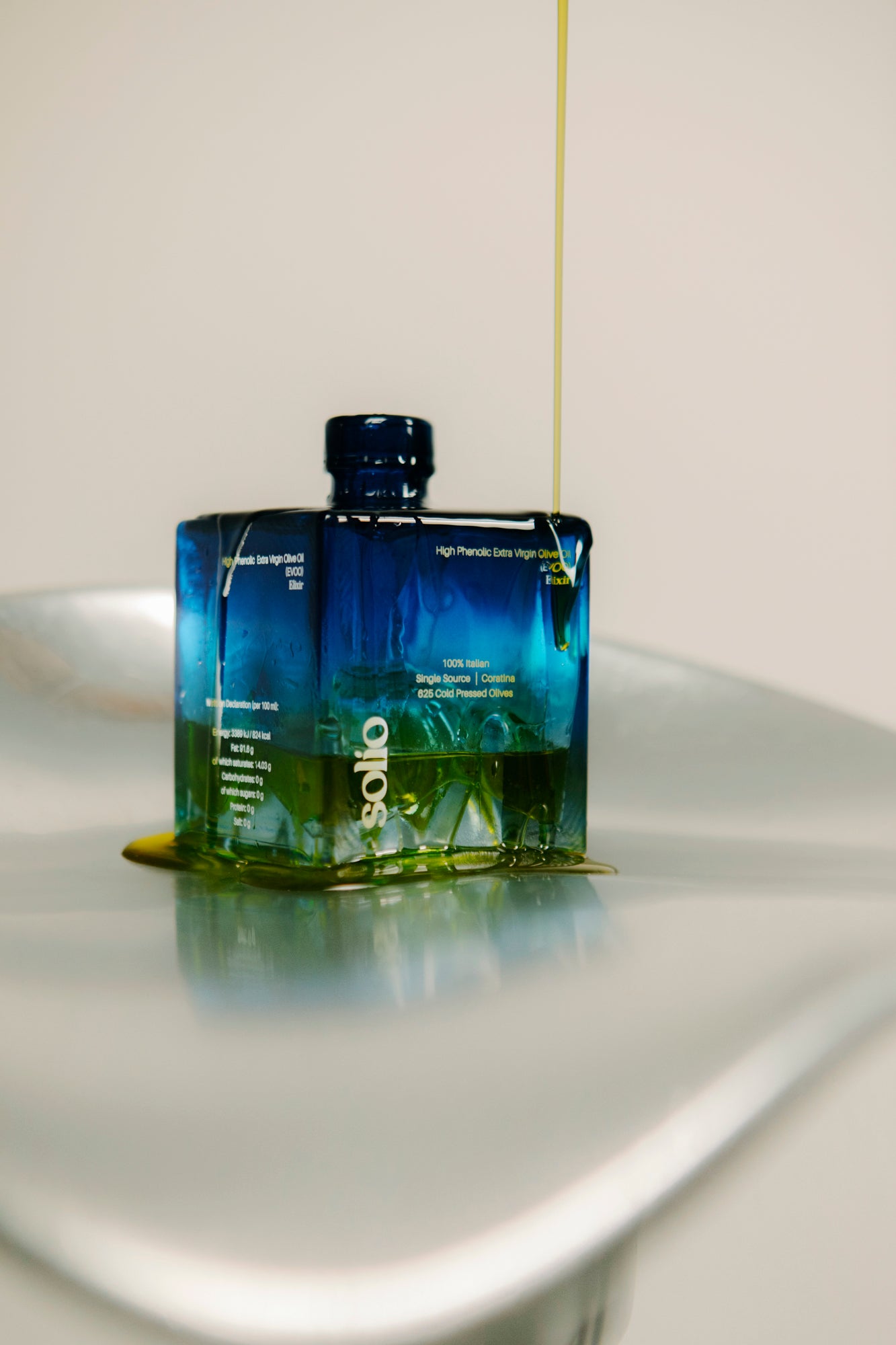
At Solio, we think about storage from the very beginning: our Coratina oil from Apulia is freshly bottled every month in small batches, in tinted 250 ml glass bottles. With a shot (10 ml) a day, a bottle is empty in just under four weeks – so the oil is never open for months. At home, the same applies: into the cupboard, close after use. We explain what makes extra virgin olive oil special in What is EVOO?

FAQ: Storing olive oil correctly
Must olive oil be kept in the fridge?
No. Olive oil keeps best in a cool (approx. 14–18 °C), dark place and well-sealed, for example in a kitchen cupboard far from the stove. The fridge is not necessary.
Can you store olive oil in the fridge?
Yes, this is possible and does not directly harm the oil. It becomes cloudy or flaky there, which disappears again at room temperature. Disadvantages are condensation when taking it out and the difficulty of dispensing the cold oil.
Storing olive oil in the fridge or not – what is better?
For most households, a cool, dark cupboard is better. The fridge is only worthwhile if your kitchen is permanently warmer than 25 °C or you want to store large quantities for a long time.
What is the best way to store olive oil?
Dark, cool, and airtight: in a dark glass bottle or tin, at about 14–18 °C, with the lid tightly closed. Not next to the stove and not on the windowsill.
What is the ideal temperature for storing olive oil?
About 14–18 °C with a temperature that is as consistent as possible. Up to around 20 °C is unproblematic; from about 25 °C, the oil ages noticeably faster.
How do you store opened olive oil?
Seal tightly after every use, keep in a dark, cool place, and consume within about 2–3 months. If consumption is slow, decant remnants into a smaller bottle so there is less air in the container.
In what kind of bottle should you keep olive oil?
Ideally in dark or heavily tinted glass or in a tin made of tinplate or stainless steel, each with a tight seal. Clear glass and plastic allow more light and air to pass through.
Does olive oil go bad in the fridge if it flakes?
No. The flakes are natural waxes and fats that have solidified. At room temperature, the oil becomes clear again, and the taste and quality remain unchanged.
 The Solio ritual
Solio: high-polyphenol olive oil with 954 mg/kg
View product →
Keep reading
- Drinking olive oil: How much, in the morning or evening, straight or with lemon? Experiences with the olive oil shot
- Olive Oil Test 2026: Which olive oil is the best? Polyphenols and laboratory values in comparison
- How long does olive oil last? Best-before date, opened shelf life, and how to spot rancid oil