

How long does olive oil last? Best-before date, opened shelf life, and how to spot rancid oil
How long does olive oil last? Unopened extra virgin olive oil generally lasts 12–18 months from bottling – which is usually what the best-before date (BBD) covers. Once opened, it is best to use it within about 2–3 months. Important: The aroma and polyphenol content decline significantly before the BBD – best-before does not automatically mean fresh.
Olive oil does not go bad overnight, but it ages from the day it is pressed. Most guides stop at “store in a cool, dark place.” We go one step further: What happens in the oil over the months, which date on the label really counts, how you can reliably recognize rancid oil, and why the time of bottling is so important.
Olive oil shelf life at a glance
| Condition | Guideline | What you should know |
|---|---|---|
| Unopened, stored properly | 12–18 months from bottling (BBD) | The best quality is in the first months after bottling. |
| Opened, tightly sealed | approx. 2–3 months for full quality | Usually still enjoyable afterwards, but flatter in taste. |
| After the BBD | often still usable | Smell and taste test decides, not the date. |
| Stored warm, in the light, or left open | a few weeks to months | Can become rancid even before the BBD. |
 The Solio ritual
Solio: high-polyphenol olive oil with 954 mg/kg
View product →
Can olive oil go bad?
Yes. Olive oil does not go bad like milk, but it oxidizes: light, heat, and oxygen make it rancid over time. Unopened extra virgin olive oil generally stays good for 12–18 months from bottling, opened for about 2–3 months. You can check whether your oil is already bad in one minute with the 3-sense test below.
Olive oil is a fresh product
Olive oil is not wine: It does not get better with time. It is most intense immediately after pressing – fruity, grassy, often bitter and peppery. From this moment, three factors work against its quality: light, heat, and oxygen. They drive oxidation, during which fatty acids, aromatic compounds, and polyphenols are gradually broken down.
Polyphenols are valuable plant compounds that provide the typical bitterness and pungency of good olive oil while also protecting the oil itself from oxidation. They are consumed in the process. That is why the polyphenol content is a good indicator of how fresh an oil still is. Learn more in our overview of polyphenols in olive oil.

What the chart shows
The model starts with an oil containing around 950 mg/kg of polyphenols. With proper storage – dark, cool, sealed – the value drops to about 640 mg/kg over 18 months, i.e., by around one-third. With improper storage, it drops to about 380 mg/kg in the same period, losing more than half. Three insights from this:
- The decline begins immediately. Even perfectly stored oil loses a little every month – the loss is never zero.
- Storage determines the pace. After one year, there is a difference of around 200 mg/kg between proper and improper storage in the model.
- The BBD says nothing about the content. An oil can be formally flawless on the last day before the BBD and still contain only a fraction of its original polyphenols.
Aromas behave similarly: The volatile fragrance compounds that make fresh oil so green and lively often evaporate even earlier. That is why an oil after a year on the shelf often tastes only “oily,” even though it is not rancid.
Harvest date, bottling date, BBD: Which date counts?
Up to three dates can be relevant on an olive oil bottle – and they mean different things.
Harvest date (harvest year)
Olives are mostly harvested in Southern Europe between October and December and pressed within a short time. The harvest year is the actual starting point of aging. It may be on the label, but it is voluntary – many oils do not state it. If you find it: The shorter ago the harvest was, the better.
Bottling date
After pressing, the oil is usually stored in tanks until bottling. If properly managed – cool, dark, and airtight – it ages more slowly there than later in the bottle. The bottling date is rarely printed, but it is crucial: From this point on, the oil enters the phase in which it is exposed to transport, storage, illuminated shelves, and your kitchen.
Best-before date (BBD)
The manufacturer determines the BBD themselves, usually 12 to 18 months from bottling. It is a quality promise: Until this date, the unopened, properly stored oil retains its typical properties. It is not an expiration date and not a best-before date. And it does not tell you when it was harvested: An oil from an older harvest that was bottled late can have a long BBD.
Rule of thumb when buying: If the harvest year is on it, pay attention to it. If not, a BBD that is still far in the future is an indication of a fresh bottling – nothing more.
Why “freshly bottled” makes the difference
In conventional retail, there are often many months between bottling and your kitchen: storage at the bottler, wholesaler, central warehouse, supermarket shelf. During this time, the oil is often warm and under artificial light, not infrequently in clear bottles. When you open the bottle, part of the possible freshness is therefore already spent – even though the BBD is still months away.

The shorter the path from bottling to you, the more of the time until the BBD is spent where it counts: with you, in the first months after opening.
Olive oil opened: Shelf life after opening
Opening introduces oxygen. Every time you take oil out, the air space above the oil gets larger, and with it the amount of oxygen that can react with the oil. That is why: Opened olive oil is best used within 2–3 months. With proper storage, it is usually still enjoyable afterwards, but the pungency, bitterness, and fruitiness decline noticeably.
- Seal tightly after every use.
- Store in a dark and cool place (approx. 14–18 °C), not next to the stove.
- Choose a bottle size that suits your consumption.
- Do not mix leftovers with fresh oil.
You can find all the details about the refrigerator, temperature, and bottle choice in our guide Storing olive oil properly: Refrigerator or not?
Olive oil expired: Can you still use it after the BBD?
Yes, often. The BBD is not a cut-off date from which the oil is spoiled. An unopened oil stored in the dark and cool can still smell and taste flawless even several months after the BBD. Conversely, an improperly stored oil can be rancid long before the BBD.
The sensory check is decisive (see below). If the oil smells and tastes clean, you can use it – preferably for cooking and frying, where aroma plays a smaller role. For salads, finishing, or pure consumption, you should reach for fresh oil instead, because that is exactly where you taste the difference. If it smells or tastes rancid, it no longer belongs in food.
Recognizing rancid olive oil: the 3-sense test
Pour one tablespoon of oil into a small glass, warm it briefly in your hand, and cover it with your other hand. Then:
- Smell: Fresh oil smells of grass, green tomatoes, herbs, artichoke, or green apple. Rancid oil smells of wax crayons, window putty, old nuts, or cardboard.
- Taste: Take a small sip and draw some air through your mouth. Fresh oil is fruity, often bitter, and scratches the throat. Rancid oil tastes flat, greasy, and oily, leaves an unpleasant aftertaste – and lacks any peppery bite.
- Look: The color is not a reliable indicator. Green or golden yellow says nothing about the quality. Cloudiness or flakes after cold are harmless.
| Fresh | Rancid | |
|---|---|---|
| Smell | grassy, fruity, green tomato, herbs | Wax crayon, putty, old nuts, cardboard |
| Taste | fruity, bitter, lively | flat, greasy, oily |
| Finish | peppery, scratches the throat | no pungency, unpleasant aftertaste |
Bitter does not mean rancid
A common misunderstanding: Bitterness and pungency are not flaws in extra virgin olive oil, but typical characteristics of a fresh, polyphenol-rich oil. Rancidity, on the other hand, is shown precisely by the lack of this liveliness. A musty, vinegar-like, or moldy smell is also a flaw – but this usually occurs during the processing of the olives and not through storage at home. How a flawless oil should taste, we explain in What is EVOO?.
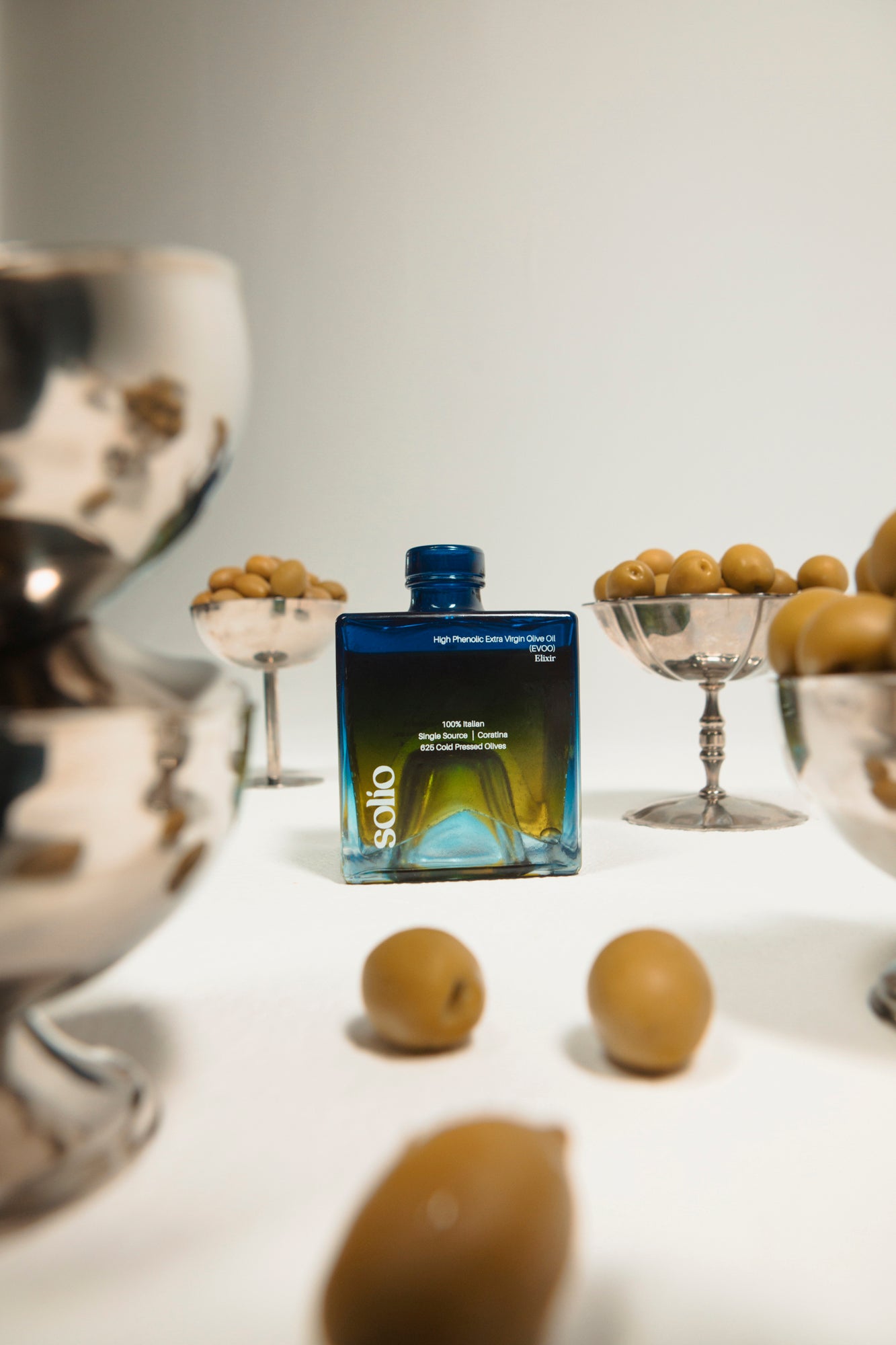
How Solio handles freshness
Our approach follows exactly the logic above: as little time as possible between bottling and your shot.
- Monthly bottling in small batches: Our Coratina oil from Puglia is not stored in bottles as a reserve, but is freshly bottled every month.
- Cool and airtight until bottling: Until then, the oil is stored cool and airtight in Puglia.
- Directly to you: After bottling, it is freshly shipped, without going through wholesalers and supermarket shelves.
- Tinted glass, 250 ml: The bottle protects against light, and with a shot (10 ml) a day, it is empty after just under four weeks – well within the 2–3 months after opening.
- Measured instead of claimed: The polyphenol content was determined in the laboratory by HPLC: 954 mg/kg.
More about origin, laboratory values, and bottling can be found on the page for Solio olive oil.
FAQ: How long does olive oil last?
How long does olive oil last?
Unopened usually 12–18 months from bottling, depending on the manufacturer's BBD. Opened best within 2–3 months. The oil has the best quality in the first months after bottling.
How long does olive oil last after opening?
For full aroma about 2–3 months, if it is kept dark, cool, and tightly sealed. Afterwards, it is usually still enjoyable, but tastes increasingly flatter.
Can you still use olive oil after the BBD?
Yes, often. The BBD is not an expiration date from which the oil is spoiled. An unopened oil stored in the dark and cool can still smell and taste flawless even several months after the BBD. If it smells of wax crayons or old nuts, or tastes flat and greasy, you should no longer use it.
How do I recognize rancid olive oil?
By the smell of wax crayons, putty, old nuts, or cardboard, and by a flat, greasy taste without pungency. The color is not a reliable indicator.
Is bitter olive oil spoiled?
No. Bitterness and pungency are typical characteristics of a fresh, polyphenol-rich olive oil. A rancid oil is rather the opposite: flat and without pungency.
What is more important: harvest date or BBD?
The harvest date, because aging begins with pressing. It is voluntary, however, and rarely appears on the label. The BBD is usually calculated from bottling and does not reveal how old the harvest is.
Does the refrigerator extend the shelf life of olive oil?
Hardly noticeable, as long as your refrigerator is cool. In the refrigerator, the oil becomes cloudy, and condensation can form when it is taken out. A dark cabinet at approx. 14–18 °C is the better choice for most households.
Does olive oil get better over time?
No. Unlike wine, olive oil does not mature. Aroma and polyphenol content decline continuously from pressing, which is why it is worth buying fresh olive oil and using it up quickly.